Most fish "aggression problems" aren't really about aggression. They start the moment two fish that should never share a tank end up in the same shopping bag — because they looked nice next to each other, not because they belong together. By the time the nipping and chasing begin, the mistake was already made at the store.
The takeaway up front: compatibility is decided before you buy, on four axes — the water each fish needs, its temperament, its adult size, and the zone of the tank it lives in. Match those four and a community tank runs itself, peacefully, for years. Ignore any one of them and you spend the tank's life managing stress you built in on purpose. This guide is about who lives with whom; for the separate question of how many fish your tank can carry, see our stocking-by-numbers guide.
What "compatibility" actually means
A "community tank" is just an aquarium where every fish can live a normal life without another fish making it miserable. That's a higher bar than "they haven't killed each other yet" — a fish can survive in the wrong company while being chronically stressed, hiding, refusing food, and wearing down its immune system until disease finishes what the stress started.
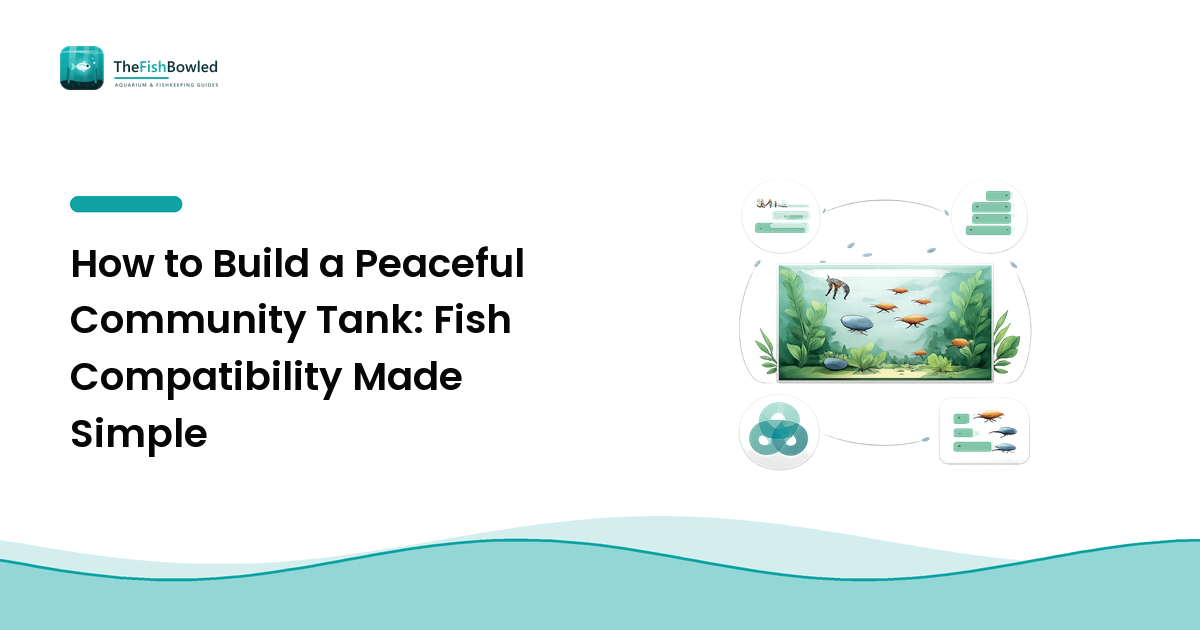
So compatibility isn't a single yes/no trait. It's the overlap of four things:
- Water needs — the temperature and water chemistry a species is built for.
- Temperament — how peaceful, bold, or territorial it is.
- Adult size — how big it gets, and whether a tankmate becomes a snack.
- Swimming zone — where in the tank it spends its life.
Two fish are compatible when all four line up. Let's take them in order — the first quietly rules out more "obvious" combinations than any of the others.
Match the water first
You can't compromise on water. A fish built for warm, soft, acidic water and a fish that needs cool, hard, alkaline water will both be stressed at any setting you pick, because none suits them both. No amount of good temperament fixes that — they're fighting the water, not each other.
Before you look at a single fin, ask whether the species share a livable range for two things:
- Temperature. Tropical community fish are generally happiest in the mid-70s °F (low-to-mid 20s °C). "Coldwater" fish like goldfish prefer it noticeably cooler, so housing them with tropical fish forces one of them to live at the wrong temperature permanently — a classic, well-meaning mismatch.
- Water chemistry (hardness and pH). Some fish want soft, acidic water; others want it hard and alkaline. You don't need lab precision, just species whose comfortable ranges overlap — and it's far easier to choose fish that suit your tap water than to fight your water chemistry for the life of the tank.
Stable water is the foundation under all of this — if the parameters themselves swing, even perfectly matched fish struggle. Our water-quality guide covers the routine that keeps them steady.
Match temperament — peaceful, semi-aggressive, and the fin-nippers
Once the water works, temperament decides whether the tank feels calm or tense. A useful shorthand sorts community candidates into three groups:
- Peaceful fish mind their own business and coexist easily — most small tetras, rasboras, corydoras, and many livebearers and small gouramis.
- Semi-aggressive fish are fine in the right setup but will bully smaller or slower tankmates, or squabble among themselves — many barbs, some larger gouramis, and many cichlids.
- Aggressive or territorial fish defend a patch of the tank and often can't share it at all.
The single most common temperament mistake is the fin-nipper. Some otherwise "peaceful" fish — tiger barbs are the textbook case — nip at slow-moving fish with long, trailing fins. Pair them with an angelfish or a fancy betta and you get shredded fins and constant stress, even though nobody gets killed outright. Two rules head this off: keep known nippers in a proper group (nipping gets much worse in small numbers), and don't mix fast, bold fish with slow, flowing-finned ones.
Match adult size — if it fits in a mouth, it's food
A gentle fish is only gentle toward fish it can't eat. "If it fits in the mouth, it's food" is one of the most reliable predictions in the hobby. A peaceful angelfish will happily eat a neon tetra small enough to swallow — not out of aggression, but because that's simply what it does.
This is why adult size, not store size, drives compatibility. Nearly every fish is sold as a juvenile, and two species that look evenly matched at the shop can end up wildly different sizes a year later. Before you buy, look up the maximum adult size of every species and picture them fully grown together. Avoid pairing fish whose adult sizes are so different that the smaller one could be swallowed — and remember that a fish outgrowing its tank creates problems no tankmate can fix.
Fill the tank's zones — top, middle, and bottom
Here's what makes a community tank feel full without feeling crowded: fish live at different levels, and a good community spreads across three zones instead of piling into the open middle.
- Top dwellers cruise near the surface — hatchetfish, many gouramis, and livebearers like guppies and mollies.
- Mid-water fish occupy the open middle — most tetras, rasboras, danios, and barbs.
- Bottom dwellers work the substrate — corydoras catfish, small loaches, and many plecos.
Choosing across zones uses the whole tank, so the aquarium looks balanced, and it reduces friction — fish that share a zone compete more than fish that don't. A single school per zone feels calmer than three schools fighting over the same stripe of water.
Respect schooling and social needs
Many of the most popular community fish are shoaling or schooling species — tetras, rasboras, corydoras, danios, most small barbs. They're wired to live in groups, and kept in twos or threes they don't just look sparse; they get stressed, skittish, and far more likely to nip. Hobby consensus is to keep them in groups of at least six, and more is usually better.
This matters for compatibility because each schooling species is a block of fish, not a single addition. When you plan, think in groups: one good school per zone, then a centerpiece if there's room. A tank of two healthy schools — say small tetras up in the open water and corydoras working the bottom — plus one calm centerpiece like a honey gourami beats a nervous tank of one-of-everything every time. Every fish in that layout shares a water range, none can eat another, and the three fill different levels. It says nothing about how many, though: compatibility tells you which fish, while bioload tells you how many.
Popular fish that are quietly incompatible
Some of the most-sold "community" fish cause the most trouble, marketed for tanks they don't actually suit:
- Common plecos are sold two inches long and grow to a foot-plus, outgrowing most home tanks and producing a heavy waste load. Smaller species suit community tanks far better.
- Goldfish are coldwater fish — pairing them with tropical species forces a permanent temperature compromise on someone, quite apart from their size and mess.
- Tiger barbs are fine in a group of their own, but as fin-nippers they're a poor match for angelfish, bettas, or anything slow and long-finned.
- Bettas are hit-or-miss community fish, and never housed with other bettas or with flashy, long-finned tankmates that trigger them.
- "Algae eater" impulse buys — the common Chinese algae eater, for instance — often turn aggressive as they grow, despite the friendly label.
None of these are "bad" fish; they're just sold for the wrong tanks. Checking a species profile before you buy catches almost all of them.
A simple process to plan your stock
Put it together as a short, repeatable routine:
- Start from your water. Note your tap water's rough hardness and the temperature you can hold, and only shortlist fish that fit it. This alone prevents the worst mismatches.
- Pick one centerpiece you love, then build the community around its needs and temperament — not the other way around.
- Add schools by zone. Choose one shoaling species for each level you want filled, keeping each in a group of six or more.
- Check adult sizes together, so nothing on the list could eventually eat anything else on it.
- Confirm each species, then check how many against your tank's capacity in the numbers guide.
- Quarantine and add in batches. Adding groups gradually protects your water and your peace; our health and troubleshooting guide covers doing it calmly.
Do this once, on paper, before you buy anything — starting from a properly cycled tank, as covered in the setup guide — and the tank you build tends to just work.
FAQ
What are the easiest fish to keep together in a community tank?
Small, peaceful, similarly sized species that share water needs and fill different zones: a school of small tetras or rasboras in the middle, corydoras on the bottom, and a calm centerpiece like a honey gourami up top. They overlap on temperature, temperament, and size, so there's nothing to fight about — provided each schooling species is kept in a group of six or more.
Can aggressive and peaceful fish ever live together?
Sometimes, but it takes deliberate planning — a bigger tank, broken sight-lines, careful groupings, and matched sizes — not luck. For a first community tank it's much easier, and kinder, to build entirely from peaceful, compatible species.
Why do my fish chase or nip each other even though they're "community" fish?
Usually one of four causes: a fin-nipping species kept in too small a group, fish crowded into the same zone, a schooling fish kept in twos or threes and stressed, or a size mismatch where a bigger fish sees a smaller one as prey. Fix the grouping, spread fish across zones, and re-check adult sizes before deciding a fish is simply "mean."
Does tank size change which fish are compatible?
It changes how many and can ease territorial friction by giving fish room to avoid each other, but it doesn't rewrite the basics — a coldwater fish still doesn't belong with tropical fish, and a small fish is still swallowable in a big tank. Use size for capacity; use water, temperament, and adult size for compatibility.
Should I quarantine new fish before adding them?
Yes. A quarantine period lets you watch new arrivals for disease before they expose an established community, and lets them recover from the stress of shipping. It's one of the simplest habits that keeps a single new fish from touching off a tank-wide outbreak.
Next step
A peaceful community tank is designed, not gambled on: match your fish on water needs, temperament, adult size, and swimming zone, keep schooling species in proper groups, and confirm every candidate before it goes in the bag. When you're ready to choose, browse the community fish profiles on The Fish Bowled to check each species' temperament, size, and water needs side by side before you buy.