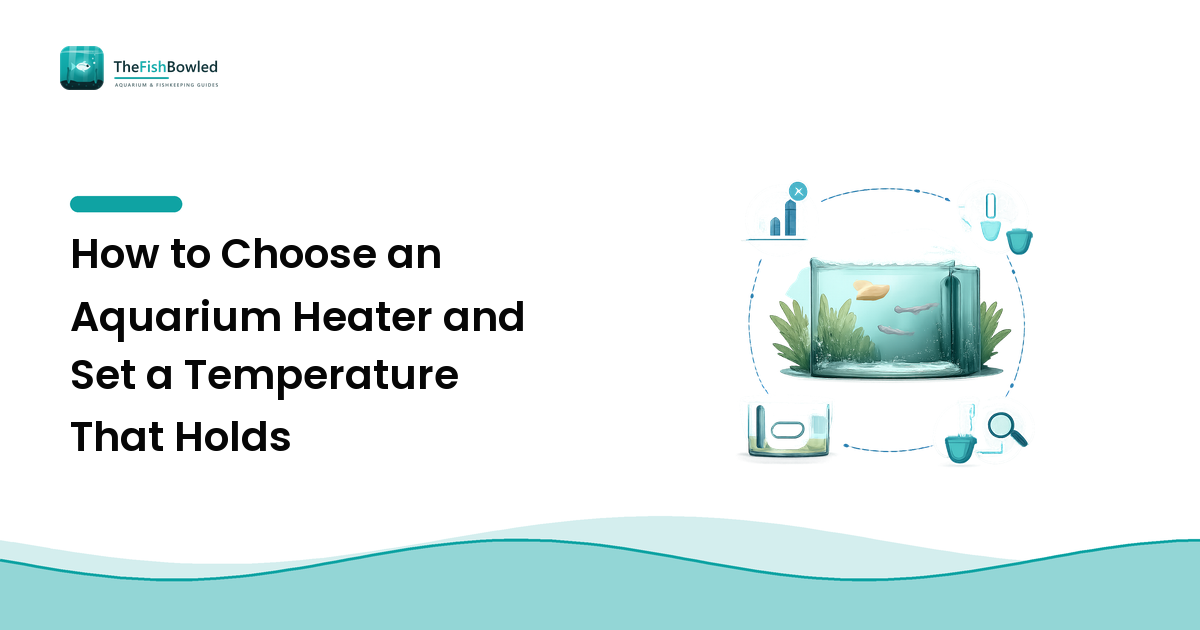
Choosing an aquarium heater looks like a wattage question and isn't. A heater's job is not to make water warm — it's to hold a temperature steady against whatever your room does, which means the right choice depends on the gap between your room's coldest hours and the temperature your fish need. Get that gap right, put the heater where the water actually moves, and verify with a thermometer the heater didn't come with.
Temperature swings stress fish in the same quiet way unstable water chemistry does: not dramatically, but by taxing them until something else — a parasite, a bad shipping week, an ammonia blip — finishes the job. A heater is cheap insurance against that, and it's one of the few pieces of gear where a failure can empty a tank in a day.
Start with the temperature your fish need
Pick the fish first, then the heater. Most common tropical community fish sit comfortably in the mid-70s Fahrenheit (roughly 23–26°C), but that's a family average, not a law — some species want it cooler, some warmer, and a few popular tank mates are quietly incompatible on temperature alone. Coldwater fish, including goldfish, generally don't want a tropical heater at all.
Two rules matter more than the exact number:
- Stability beats precision. A tank held steadily at one temperature within a species' range does better than one bounced around inside that range every day.
- Overlap decides your stock. If two species' comfortable ranges barely touch, they're a poor pairing regardless of temperament — a point we work through in the freshwater parameter chart.
Look up the species you actually plan to keep, take the overlap of their ranges, and set your target in the middle of it.
The heater types, compared
There are only a handful of formats, and they trade off differently.
Submersible heaters are the default: a sealed tube containing an element and a thermostat, fully submerged in the tank. They are inexpensive, widely available, and easy to reposition. Trade-off: the thermostat reads the water immediately around the tube, so placement and flow matter a lot, and the cheapest units drift furthest from their dial markings.
Shatter-resistant heaters wrap the element in plastic, composite, or metal rather than glass. Worth the extra cost in tanks with large, boisterous fish or anything that redecorates — a cracked glass heater is both a dead heater and an electrical hazard. Trade-off: usually pricier, sometimes bulkier, and metal-bodied units are not appropriate for shrimp and other invertebrates if the alloy can leach.
Preset / nano heaters ship with a fixed temperature and no dial. They're a reasonable fit for small tanks whose ideal temperature happens to match the preset, and for keepers who'd otherwise knock a dial. Trade-off: no adjustment when you change stock, and if the preset is off, you can't correct it — you can only replace the unit.
In-line heaters sit outside the tank on a canister filter's return hose, heating water as it passes. They remove hardware from the display, which aquascapers like, and they heat water that is already moving. Trade-off: they require a canister or pump loop, cost more, and become another joint that can leak.
Substrate cables and heating mats are niche. They're slow, hard to service, and rarely the primary heat source in a modern freshwater tank.
For most home tanks, a decent submersible — or two, see below — is the sensible answer. Choose shatter-resistant if you keep big fish, and in-line only if you already run a canister, which the filter guide can help you decide.
Sizing the wattage to your room, not the box
The common hobby rule of thumb is roughly 3 to 5 watts per gallon (very roughly 1 watt per litre), and like all rules of thumb it hides the variable that actually matters: how far your room drops below your target temperature, and for how long.
A 30-gallon tank in a heated living room that never falls below the low 70s needs far less wattage than the same tank in an unheated garage that hits the 50s overnight. Work it through in that order:
- Find your target tank temperature.
- Measure your room's coldest point — overnight, in the coldest season, not a comfortable afternoon.
- The bigger the gap, the more wattage per gallon you need.
- Check the manufacturer's sizing chart for the model you're buying. Most publish one, and it will be specific to that heater in a way no generic rule can be — use it as the final word.
Two smaller heaters usually beat one large one in tanks big enough to hold them. Split the wattage roughly in half. If one sticks in the "on" position, half the power is less likely to cook the tank; if one fails off, the other carries most of the load until you notice. In a small tank where two won't fit, an external temperature controller does a similar job (below).
Resist the urge to oversize "for safety". An enormously overpowered heater in a small tank is the exact configuration that turns a stuck thermostat into a disaster.
Placement and flow
A heater's thermostat only knows the water touching it, so put it where water is moving.
- Mount it near the filter outflow or an area of good circulation, not in a dead corner behind the hardscape. Still water lets the heater satisfy itself early while the far end of the tank stays cool.
- Fully submerge it, up to the manufacturer's line, and mount it horizontally low in the tank or at an angle — warm water rises, so a heater near the bottom mixes more evenly.
- Keep it away from substrate contact and out of reach of a plow-happy fish.
- Unplug it before a water change. A heater running in air can crack when the water returns; several models are rated to run dry, but "rated" is not a reason to test it. Wait a few minutes after refilling before switching it back on.
Verify, don't trust the dial
Treat the heater's own markings as an approximation and confirm with an independent thermometer — a simple glass or digital unit at the opposite end of the tank from the heater. Two readings, two places, is what tells you the tank is heating evenly.
The check that matters is over time, not at a glance:
- Set the heater and let the tank run for 24 hours.
- Read the thermometer at your room's coldest hour (usually early morning) and again in the evening.
- If the two readings sit within about a degree of each other and both land in your target range, you're done. If the morning reading is well below target, the heater is undersized for your room — or sitting in dead water.
Adjust the dial in small increments and wait a full day between changes. Chasing the temperature with big adjustments creates exactly the instability you bought the heater to prevent. The same patient rhythm applies to the rest of your maintenance, which the water quality guide lays out.
Failure modes worth knowing
Heaters fail in three ways, and each has a signature.
Stuck on. The thermostat welds closed and the heater runs continuously. Temperature climbs, fish gasp at the surface, and warm water holds less oxygen — this is the dangerous one. A separate plug-in temperature controller, which cuts power at a set ceiling regardless of what the heater thinks, is the standard defence, and it's the single best upgrade for anyone keeping sensitive or valuable stock.
Stuck off. The tank drifts down to room temperature. Slower and usually survivable if caught, which is why the morning thermometer check earns its keep.
Slow drift. The unit gradually reads a degree or two off. Harmless if you notice, invisible if you never look. Glance at the thermometer whenever you feed.
If a heater's indicator light behaves strangely, the glass is cracked, or condensation appears inside the tube, replace it. There is no repair worth attempting on a sealed electrical device sitting in water.
FAQ
What size heater do I need for my tank? Start from the rule-of-thumb range of about 3–5 watts per gallon, then adjust for how cold your room gets overnight — a bigger room-to-target gap needs more wattage. Confirm against the sizing chart for the specific model you're buying, since designs differ.
Do I need a heater for a goldfish or coldwater tank? Usually not for warmth, but a heater set low can still be useful to prevent sharp drops in an unheated room. Coldwater fish are harmed by heat far more often than by cool, stable water, so never run a tropical setting on them.
Should I use one heater or two? Two half-wattage heaters in tanks large enough to hold them, because a single failure then affects half the heat rather than all of it. In small tanks, use one appropriately sized heater and consider an external controller as the backup.
Where exactly should the heater go? In good flow — near the filter outflow — fully submerged, low in the tank, and away from substrate and dead corners. Put your thermometer at the far end so you're measuring the tank, not the heater.
Why does my tank temperature keep changing? Most often the room, not the heater: sun through a window, a vent, an exterior door, or an open lid with lots of evaporation. Check placement and room conditions first, then whether the heater is undersized for your coldest hours, and only then suspect the unit itself.
Next step
Buy for the gap between your room and your target, split the wattage where you can, place the heater in the flow, and let an independent thermometer be the judge. If you're still assembling the rest of the tank, the aquarium setup guide covers the order everything goes in. For species temperature ranges, care guides, and side-by-side gear comparisons as you shop, browse The Fish Bowled.