Buy the wrong filter and everything downstream gets harder: cloudy water, stressed fish, a tank you're forever fiddling with. Buy the right one and it disappears into the background for years. The filter is the single most important piece of equipment in an aquarium — and it's also the one beginners most often oversize, undersize, or misunderstand.
The takeaway up front: the best aquarium filter is the one matched to your tank's size, your fish's tolerance for flow, and the biological load you're putting on it — not the one with the biggest number on the box. Get those three right and almost any filter type will serve you well. This guide covers what a filter does, compares the five types with their honest trade-offs, and shows how to size one so you buy once.
What an aquarium filter actually does
A filter isn't there to "clean the water" in one vague sense. It does up to three distinct jobs, and only one of them keeps fish alive.
- Mechanical filtration traps physical debris — uneaten food, waste, plant bits — in a sponge or floss so the water runs clear. This is the visible job, and the least important to fish health. Clear water can still be toxic water.
- Biological filtration is the real point of a filter. The media provides a large surface for the beneficial bacteria that run the nitrogen cycle, converting the toxic ammonia in fish waste into nitrite and then into far less harmful nitrate. This is why you never let a filter sit switched off for long or rinse its media under the tap — you would kill the bacterial colony and crash the tank.
- Chemical filtration uses media like activated carbon to adsorb dissolved compounds — tannins, odors, leftover medication. It's useful in specific situations, not a permanent requirement.
Every filter type below handles mechanical and biological filtration; they differ in capacity, flow, gentleness, cost, and upkeep.
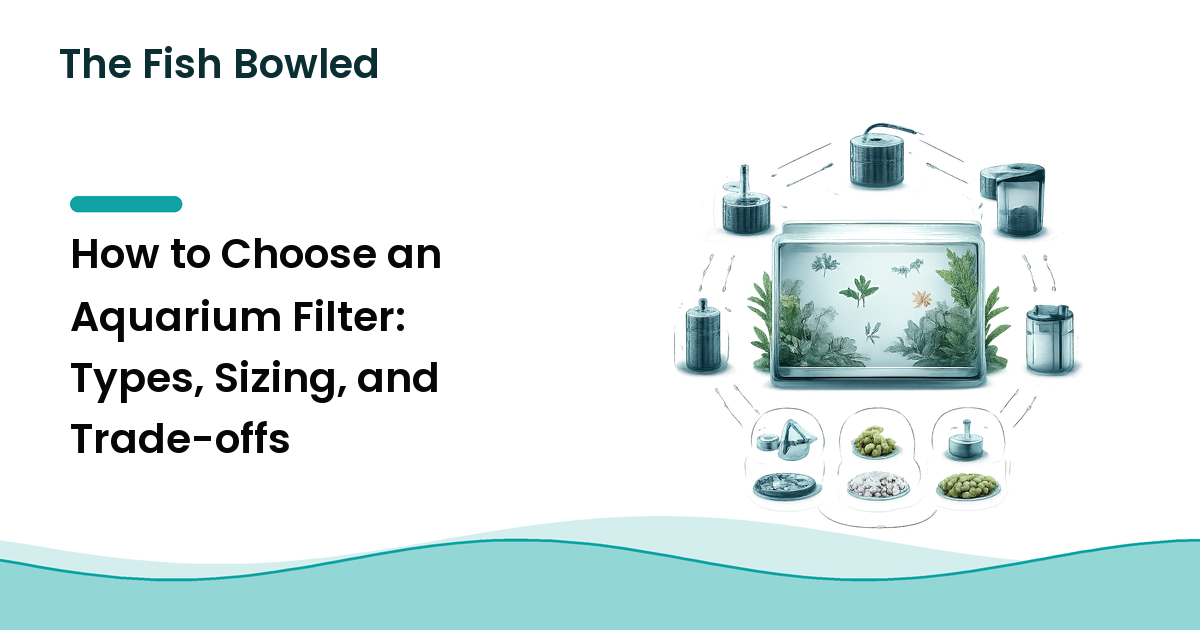
The five aquarium filter types, compared
| Filter type | How it works | Best for | Flow | Main trade-off |
|---|---|---|---|---|
| Sponge | Air pump pulls water through a sponge | Fry, shrimp, bettas, quarantine, nano tanks | Gentle | Little mechanical polishing; needs an air pump; sits in view |
| Hang-on-back (HOB) | Hangs on the rim, pumps water through a media chamber | Most 10–55 gal community tanks | Moderate–brisk | Modest media volume; outflow can be strong for slow fish |
| Internal | Submerged powered box or block | Nano and small tanks; extra flow | Adjustable | Takes up in-tank space; limited capacity |
| Canister | Sealed external unit with stacked media trays | Larger (40 gal+), heavily stocked or planted tanks | Strong, tunable | Higher cost; more involved to open and clean |
| Undergravel (UGF) | Plate under the gravel pulls water down through the substrate | Simple, budget setups | Gentle | Dated; clogs; incompatible with sand and planted tanks |
A few words on each:
Sponge filters are quiet overachievers: cheap, nearly impossible to misuse, and superb biological media with gentle, fry-safe flow — which is why breeders, shrimp keepers, and quarantine tanks rely on them. Their weakness is polishing, and they need an air pump running alongside.
Hang-on-back filters are the default all-rounder — easy media access, right for most beginner community tanks. The trade-offs are a limited media chamber and an outflow that can be brisker than long-finned fish enjoy.
Internal filters are submerged powered units, handy for nano tanks or as extra flow in a bigger one; they cost you in-tank space and don't hold much media.
Canister filters are the workhorses for larger, heavily stocked, or planted tanks: sealed outside the tank, they hold lots of media, run quietly, and push strong, tunable flow. In return they cost more and take real effort to service — overkill on a small tank.
Undergravel filters pull water down through the gravel. Cheap and simple, but they clog, are awkward to maintain, and don't suit sand or planted substrates — newer options have largely replaced them.
If you want a single default: for a typical first community tank, a HOB or a sponge filter is the pick — the HOB for polishing and easy media access, the sponge for gentleness and rock-solid biological reliability. Both are forgiving and hard to get wrong; canisters earn their price on bigger, dirtier, or showcase tanks.
How to match a filter to your tank and fish
Four things decide which type fits:
- Tank size and stocking (bioload). More fish, or bigger and messier fish, means more waste and more demand for biological capacity — a lightly stocked 20-gallon and a goldfish-packed 40-gallon are not the same job. If you're still working out your stocking, our aquarium setup guide covers planning the whole tank before you buy gear.
- Your fish's tolerance for flow. This is a welfare issue, not a preference. Bettas, fancy goldfish, and many slow, long-finned fish are exhausted by strong current, while some barbs and hillstream loaches want a river. Never make a betta fight a ripping HOB outflow — baffle it or choose a gentler filter.
- Planted or bare, sand or gravel. Sand and planted tanks rule out undergravel filters and reward the large biological capacity of a canister or a well-chosen HOB.
- The maintenance you'll actually keep up. A canister needs servicing less often but takes longer each time; sponges and HOBs are quick and frequent. Be honest about which rhythm you'll keep.
How to size a filter (turnover, not just the box rating)
The "rated for up to X gallons" number on the box is optimistic marketing. Two better checks:
- Turnover, measured in GPH (gallons per hour). A common starting point for a community tank is a filter that moves roughly 4 times your tank's water volume per hour — so a 30-gallon tank wants around 120 GPH. Messy, heavily stocked tanks (goldfish, cichlids) benefit from 6x and up; gentle, lightly stocked tanks can run less. It's hobby consensus and a starting point, not a hard law.
- Real-world derating. Media, plumbing height, and gradual clogging all cut actual flow below the rated GPH. So size up rather than to the exact minimum: better to gently over-filter — and baffle any excess flow — than to run a filter at its limit.
One myth worth killing: a bigger filter does not fix an overstocked tank. It processes waste, but it doesn't create swimming room or remove nitrate — only water changes do that. Size your fish load to the tank first, then filter it well.
Filter mistakes that quietly cost you fish
- Rinsing media under the tap. Chlorine kills the beneficial bacteria your fish depend on — always rinse media in a bucket of old tank water instead.
- Replacing all the media at once. That throws out your whole biological colony. Replace in stages, keeping old media alongside the new so bacteria can migrate across.
- Leaving the filter off too long. Switched off, the bacteria start to suffocate within an hour or two, so work quickly during maintenance and keep the media wet.
- Chasing flow numbers over fish comfort. A fish pinned to the glass or hiding from the current is telling you the flow is wrong — add a baffle, a spray bar, or a gentler filter.
- Skipping filtration because "the plants will handle it." Live plants help, but in a stocked tank they don't replace biological filtration. A sponge filter is the minimum.
A quick filter-buying checklist
- Right type for your tank size and fish — sponge or HOB for most beginners.
- Turnover around 4x tank volume, sized up for messy or heavily stocked tanks.
- Flow gentle enough for your least flow-tolerant fish.
- Enough biological media capacity, and media that's easy to access.
- Compatible with your substrate and plants.
- A maintenance rhythm you'll realistically keep up.
- Quiet enough for the room it lives in.
FAQ
What kind of filter is best for a beginner aquarium?
A hang-on-back (HOB) or a sponge filter — both are affordable, forgiving, and hard to misuse. Pick the HOB for a typical community tank where you want polished water and easy media access; pick the sponge for gentle flow and reliable biological filtration, especially in nano and quarantine tanks or those with bettas, shrimp, or fry.
How big a filter do I need for my tank?
Size by turnover, not the box's gallon rating. A good starting point is a filter moving about four times your tank's volume per hour — roughly 120 GPH for a 30-gallon tank — and more for messy or heavily stocked fish. Because media and clogging reduce real flow, size up rather than to the exact minimum.
Hang-on-back vs canister filter — which should I get?
It depends on the load. For most 10–55 gallon community tanks, a HOB is simpler, cheaper, and plenty. A canister earns its higher cost and more involved maintenance on larger tanks (roughly 40 gallons and up), heavily stocked tanks, or planted display tanks, where its large media volume and strong, tunable flow matter.
Can I clean my aquarium filter with tap water?
No. The chlorine or chloramine in tap water kills the beneficial bacteria in your media, which can crash your nitrogen cycle and spike ammonia. Rinse media in a bucket of old aquarium water instead, just enough to clear the gunk — you want it clean, not sterile.
Do I really need a filter, or can live plants replace it?
In a stocked tank, you need a filter. Plants absorb some ammonia and nitrate and genuinely help, but they don't provide the concentrated biological filtration a colony of fish requires. At minimum, run a sponge filter — plants and filtration work best as partners, not substitutes.
How often should I clean my aquarium filter?
When flow visibly drops — often every few weeks — rather than on a rigid schedule. Rinse the mechanical media in old tank water, leave the biological media largely alone, and never replace everything at once. Cleaning too aggressively can set back your bacteria as surely as never cleaning clogs your flow.
Next step
Choosing a filter isn't about the most powerful unit — it's about matching the type to your tank, sizing it for real turnover with room to spare, and keeping it gentle enough for your fish. Get that right and it becomes the quietest, most reliable part of the hobby. For more calm, welfare-first, vendor-neutral fishkeeping guides, visit thefishbowled.com.