You filled a brand-new fish tank yesterday and woke up to a white fog where clear water used to be. The instinct is to panic, dump in a "water clarifier," and change half the water on the spot. Hold off — most cloudy water is a normal stage of a tank finding its balance, and the wrong fix often resets the clock or worsens the haze.
The takeaway up front: cloudy aquarium water is a symptom, and the cause is written in the color. A white or gray haze is almost always a bacterial bloom or fine debris; a green tint is suspended algae; a sudden cloud after adding gravel or rock is just dust. Identify which one you have, fix the actual cause, and the water clears on its own. Reaching for a chemical clarifier before you know the cause only hides the problem.
First, read the color of the cloud
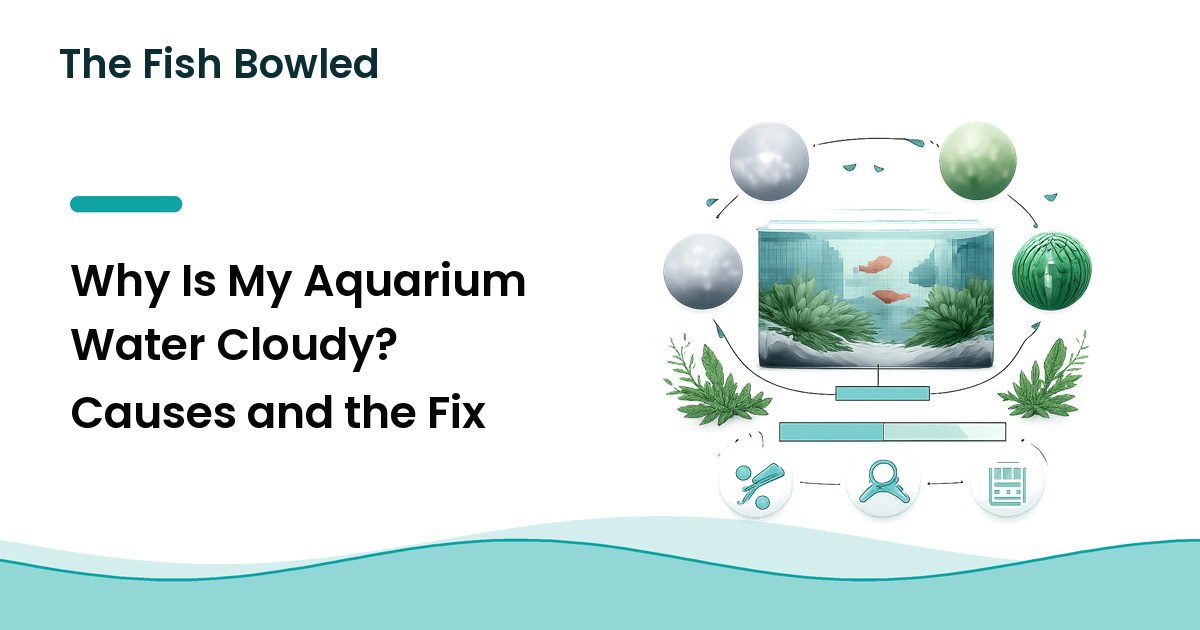
If you're asking why is my fish tank cloudy, start here: look at the tank in good light and decide which of three things you're seeing before changing anything. This single step decides everything else.
- White cloudy aquarium water, milky and evenly spread — most often a bacterial bloom, a population spike of free-floating microbes. This is the classic "new tank" cloud.
- Green, like weak tea or pea soup — free-floating algae, a "green water" bloom driven by light and nutrients. Different cause, different fix.
- Hazy right after you added substrate, rock, or wood, clearing from the bottom up — physical dust and fine particles stirred into the water. The most harmless kind.
Get this right and you avoid the most common mistake in the hobby: treating a bacterial bloom like an algae problem and wondering why nothing works.
White or gray cloud: the bacterial bloom
A bacterial bloom in an aquarium scares beginners most and is usually the least dangerous. When a tank is new — or recently disturbed by a big water change, a deep gravel clean, or extra food — a brief surplus of dissolved nutrients appears, and free-floating bacteria multiply fast to consume it. A few billion at once turn the water cloudy. It typically shows up days into a new setup and is so common it has a nickname: new tank syndrome.
The crucial point: a bacterial bloom is not the beneficial bacteria from your nitrogen cycle. Those live on surfaces — filter media, substrate, and decor — not floating in the water. So a bloom is not a sign your cycle is "working," and clearing the cloud does nothing to your established colonies.
The fix is patience, not chemicals. A bloom is self-limiting: once the bacteria exhaust the surplus, their population crashes and the water clears, usually within a few days to a couple of weeks. What helps:
- Stop overfeeding. Excess food is the most common fuel. Feed lightly, or skip a day — fish are fine without a meal.
- Don't tear the tank apart. Resist big water changes and deep gravel vacuums while it clears; over-cleaning removes the maturing balance and can prolong the cloud.
- Keep the filter running and undisturbed. Mechanical media gradually traps the particles. Don't rinse it mid-bloom.
- Verify safety with a test, not your eyes. Cloudy water looks dangerous but is often harmless; the real risk is invisible ammonia. If there are fish in the tank, test the water — a liquid test kit tells you what's actually safe and whether a water change is genuinely warranted, which the haze alone never can.
If a test shows ammonia or nitrite above zero, that is the real emergency — not the cloud. Treat the toxicity with a partial water change and a conditioner, and the haze becomes secondary.
Green water: a suspended-algae bloom
If the tint is green rather than white, it isn't a bloom at all. Green water in an aquarium is microscopic algae suspended in the water column, multiplying because it has the two things every plant wants: light plus nutrients. Common triggers are direct sun, the light left on too long, or nitrate and phosphate from overfeeding and skipped maintenance.
This distinction matters because the green-water fix is the opposite of the bloom fix: a bloom wants patience, while green water won't clear on its own — you have to actively cut the light and export the nutrients feeding it. Because that driver and cure are the same as every other algae problem, the full playbook lives in our guide on how to get rid of aquarium algae: trim the light schedule, restore regular water changes, and let healthy plants outcompete it for nutrients.
Hazy after a water change or new substrate: just dust
The most reassuring case. If the water clouded the moment you poured in new gravel or sand, you're almost certainly looking at fine dust stirred off the substrate — sand and some gravels carry a surprising amount of powder even when they look clean. It isn't biological at all, and it clears mechanically:
- Rinse substrate before it goes in. Rinsing gravel or sand in a bucket until the runoff runs clear prevents most of this.
- Let the filter do its job. Mechanical filtration pulls the particles out over a few hours to a day; fine floss clears it faster than a coarse sponge.
- Give it time. Heavier particles settle on their own. A cloud clearing from the bottom upward is dust settling — exactly what you want.
If new-substrate haze hasn't cleared after a day or two and instead turns white and stays, reassess — it may have tipped into a bacterial bloom as the tank starts to cycle.
When cloudy water is actually a warning
Most cloudiness is benign, but read it in context. Take it seriously when the cloud comes with stressed fish — gasping at the surface, clamped fins, sudden lethargy — because that points to an ammonia or nitrite problem coinciding with, or causing, the haze. Be cautious, too, if a long-established, crystal-clear tank suddenly clouds for no obvious reason; test the water to rule out a spike from a dead fish, a decaying plant, or missed overfeeding. The cloud itself rarely harms fish — the toxic water sometimes hiding behind it is what does.
FAQ
Will cloudy water hurt my fish?
Usually not directly. A bacterial bloom or substrate dust is mostly cosmetic, and fish tolerate it fine. The danger is what you can't see: if the cloudiness comes with an ammonia or nitrite spike, that toxicity can harm fish. So judge safety with a water test, not by how cloudy the tank looks — and watch the fish for signs of stress.
How long does cloudy water take to clear?
It depends on the cause. Substrate dust clears in hours to a day as the filter pulls it out. A bacterial bloom is self-limiting and typically clears within a few days to about two weeks, once the surplus runs out. Green water lasts until you correct the light and nutrients feeding it. If a white cloud persists well beyond two weeks, hunt for an ongoing fuel source like overfeeding.
Should I do a water change to clear cloudy water?
Not as a reflex. For a bacterial bloom, large or frequent water changes can prolong it by disturbing the balance the tank is reaching — patience works better. Change water when a test shows ammonia or nitrite, or when you're exporting nutrients to fight green water. Let the reason, not the appearance, decide.
Do water clarifier products work?
They can make a cloud drop out faster by clumping fine particles so the filter catches them, but they treat the symptom, not the cause. If a bloom is driven by overfeeding or a maturing tank, the haze often returns until you fix that. Treat a clarifier as an occasional cosmetic tool, not a substitute for finding why the water clouded — and never as proof the tank is cycled, which only a water test confirms.
Next step
Cloudy water almost always resolves itself once you read the color, identify the cause, and stop fueling it — a bloom needs patience, green water needs less light and fewer nutrients, and dust just needs the filter and time. The one thing the cloud can hide is genuinely dangerous water, so when there are fish in the tank, let a test kit, not your eyes, decide whether anything is wrong. For the routines that keep a tank clear in the first place, start at thefishbowled.com.