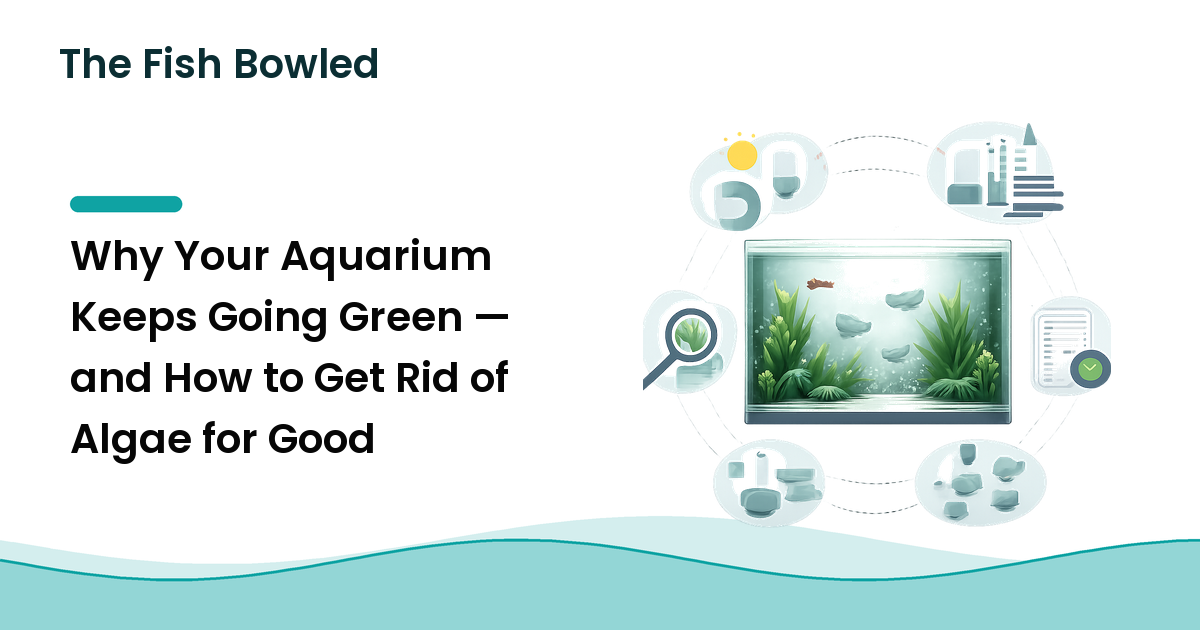
You scrub the glass on Sunday, and by the next weekend it's hazy green again. You wipe the leaves, and a week later they're furry brown. The usual advice — "just clean it" — never makes it stop, because cleaning treats the symptom, not the cause.
The key takeaway up front: algae is not a disease and it's not bad luck — it's a sign that your tank offers more light and more nutrients than your plants and fish can use. You don't beat algae by scrubbing harder; you beat it by removing the surplus. Get light and nutrients into balance and it quietly starves, often for good. This guide shows you how to read which algae you have and fix the real driver.
Why algae shows up in the first place
Every aquarium has algae spores in it — they arrive on plants, on fish, and in tap water, and there's no keeping them out. Algae in a fish tank only becomes a problem when conditions tip in its favor. Three ingredients drive a bloom: light, nutrients (mainly nitrate and phosphate), and time. Give algae all three and it explodes; take one away and it stalls.
So a green tank isn't telling you "you have algae" — it's telling you "there's more light and food here than anything else can absorb." The common culprits behind that surplus are simple and fixable:
- Too much light. A fixture left on 10–12 hours, or a tank in direct sun near a window, is the single most common cause. More light than your plants can use is just free energy for algae.
- Excess nutrients. Overfeeding, too many fish, and skipped water changes let nitrate and phosphate climb. Those are plant fertilizers — and algae are plants too.
- A new or unbalanced tank. Fresh setups settle in before their biology stabilizes; early algae waves are normal and usually pass.
- Too few live plants for the light you're running. With nothing fast-growing to claim the nutrients, algae claims them instead.
What's not on that list: bad luck. Algae is a feedback signal — once you read it that way, the fix follows logically.
Identify your algae before you fight it
The common aquarium algae types each point to a different cause, so naming yours tells you where to look. No microscope needed — appearance and feel are enough.
Brown algae (diatoms) — the new-tank dust
A soft brown coating on glass, gravel, and leaves that wipes away easily. This is the classic "new tank" algae, feeding on silicates and surplus nutrients while a young system settles. It's the least worrying type: in most fresh setups it appears in the first few weeks and fades as the tank matures.
Green spot and green dust — the bright-light algae
Hard green dots on the glass and slow-growing leaves, or a fine green film that clouds the glass within days of cleaning. Both lean toward strong or long lighting. Green spot in particular clings stubbornly — it's telling you to look hard at light duration and intensity.
Green water — the pea-soup bloom
Green aquarium water that turns cloudy until you can't see the back of the tank. This is free-floating algae multiplying in the water column, almost always driven by excess light plus excess nutrients — often a tank in direct sunlight or one that's been overfed. It looks alarming but is rarely harmful to fish; it's an eyesore flagging a surplus to correct.
Black beard / black brush algae — the stubborn one
Dark, bristly tufts that grip hardscape, equipment, and leaf edges, often where flow is strong. Hobbyists dread it because it resists scrubbing and isn't grazed by most cleanup animals. It's frequently linked to unstable conditions and fluctuating CO2 or nutrients in planted tanks. It rarely vanishes overnight, but steady conditions plus removing affected leaves brings it under control.
Hair / thread algae — the green strands
Long green filaments draped over plants and décor, easy to twirl out on a toothbrush. Usually a sign of surplus nutrients and light with too little plant competition; manual removal plus a tighter balance is the route.
The pattern across all five: the name changes, but the levers — light, nutrients, plant competition, stability — stay the same.
The fix that actually lasts
This is the part that ends the weekly scrub — work the levers, not the glass:
-
Cut the light first. Put the fixture on a timer at 6–8 hours a day in one continuous block; long "split" photoperiods often feed algae more than plants. Move the tank out of direct sunlight, and dial back a brightness setting that's cranked. This resolves more algae than anything else.
-
Bring nutrients down. Feed less — only what the fish finish in a couple of minutes, once a day — and make sure you aren't overstocked. Then do consistent water changes to export nitrate and phosphate; the routine that keeps those in check is the same one in our water-quality guide, and it's the backbone of every algae fix.
-
Put plants on your side. Add fast-growing live plants — stem plants and floaters are the classic workhorses. They consume the very nutrients algae wants and shade the tank, so a well-planted aquarium is the most reliable long-term control there is: it simply outcompetes algae.
-
Remove what's there, gently. Scrape the glass, wipe hardware, twirl out hair algae, and prune badly affected leaves. Manual removal speeds recovery, but it's the finishing touch — scrubbing without fixing light and nutrients only resets the clock.
-
Consider a modest cleanup crew — with realism. Certain snails, shrimp, and algae-grazing fish nibble films and soft growth. They're a supplement, never a substitute: add them only if they suit your tank, and never overstock just to chase algae.
-
Then be patient. Algae took weeks to bloom and recedes over weeks, not hours. Hold the new light schedule and water-change rhythm steady — stability is what finally starves it; constant tinkering keeps a tank swinging and the algae fed.
What to avoid: don't reach for an "algae killer" liquid first. Chemical treatments can knock back a bloom, but if the light-and-nutrient surplus remains the algae returns — and a sudden die-off can foul your water. Fix the cause; reserve treatment for stubborn cases, used sparingly.
FAQ
Why does my aquarium keep turning green no matter how often I clean it?
Because cleaning removes algae but not the conditions that grow it — if light and nutrients stay high, it blooms right back. The lasting fix is to shorten the light period to 6–8 hours, get the tank out of direct sun, and keep nitrate and phosphate down with regular water changes.
Is algae harmful to my fish?
Most common algae isn't directly dangerous — even pea-soup green water is more eyesore than health threat. The bigger concern is what it signals: a nutrient surplus, often from overfeeding or overstocking, that also stresses fish and can worsen day-to-night oxygen and pH swings.
How long does it take to get rid of aquarium algae?
Plan on a few weeks of consistency, not a quick fix. Once you cut the light and bring nutrients down, existing algae stops spreading fairly quickly, but clearing it and reaching a stable balance takes time — especially for green water and black beard algae.
Do I need to buy an algae-killing chemical?
Usually no. For most tanks, fixing light and nutrients plus manual removal and live plants solves it without any chemical. Treatments only mask the problem if the cause remains — reserve them for stubborn cases, dosed carefully.
Will live plants really reduce algae?
Yes — it's one of the most reliable long-term controls. Fast-growing plants consume the nitrate and phosphate algae depends on and shade the tank, outcompeting it for the same resources. A densely planted aquarium stays far clearer than a bare one under the same light.
Next step
Stop fighting algae at the glass and fight it at the source: cap the light at 6–8 hours, feed less, tighten your water changes, and let a few fast-growing plants claim the nutrients first. Then hold it steady and let the bloom starve. The goal isn't a tank you scrub every Sunday — it's a balanced one that simply doesn't go green. For more calm, vendor-neutral fishkeeping guides, visit thefishbowled.com.